Artificial Intelligence Everywhere in 2026: Explore how AI is reshaping jobs, healthcare, education, and modern life worldwidehttps://trendyviralhub.com/.
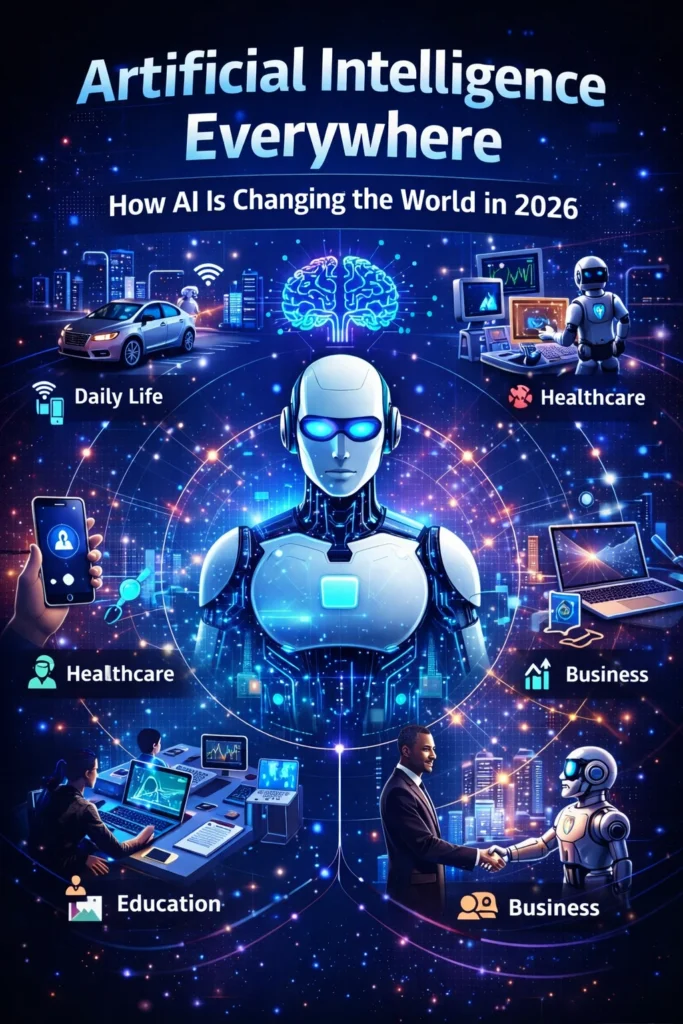
AI in Daily Life
Every day, we use AI without thinking about it. Your phone suggests the fastest route. Your music app recommends songs. Online stores show products based on your interests.
Because AI learns from your behavior, it gives better suggestions over time. As a result, life feels more personal and simple.
In 2026, smart homes also use AI. Lights adjust automatically. Security systems detect unusual activity. These tools make homes safer and more efficient.
AI in Healthcare
Healthcare has changed in big ways. AI helps doctors find diseases earlier. It studies medical images and finds patterns quickly.
For example, AI can detect health problems in scans within seconds. This helps doctors act faster. Early treatment often saves lives.
Wearable devices also track heart rate, sleep, and activity. If something seems wrong, users get alerts. Therefore, people can take action sooner.
AI does not replace doctors. Instead, it supports them with better data.
AI in Business and Jobs
Many businesses now use AI tools. These tools handle repetitive tasks like data entry and scheduling. Because of this, workers can focus on creative and important tasks.
Customer service has improved too. Chat systems answer simple questions instantly. Meanwhile, human staff solve complex problems.
Although some jobs change, new ones are created. Companies need AI experts, data analysts, and tech specialists. So the job market is evolving, not disappearing.
AI in Education
Education is becoming more flexible. AI learning platforms adjust lessons based on student progress.
If a student struggles, the system gives extra help. If a student learns quickly, it provides harder tasks. As a result, learning becomes more personal.
Teachers also benefit. AI helps grade work and track progress. Therefore, teachers spend more time guiding students.
AI in Smart Cities
Cities are using AI to improve daily life. Traffic lights adjust to reduce congestion. Energy systems reduce waste. Public transport runs more smoothly.
AI also monitors air quality and weather conditions. When problems appear, officials can respond quickly.
These systems make cities cleaner, safer, and more efficient.
Creativity and AI
AI is helping creative people too. Designers use it to test ideas. Writers use it for brainstorming. Musicians experiment with new sounds.
However, humans still control the final result. AI offers support, but creativity remains human.
This partnership is growing stronger every year.
Challenges to Consider
Even though AI offers many benefits, it also raises concerns. Privacy is a major issue. AI systems use data, so companies must protect it.
There are also ethical questions. AI must be fair and unbiased. For this reason, many governments are creating new rules.
Responsible use of AI is important for the future.https://www.ibm.com/topics/artificial-intelligence
Leave a Reply